
It's Probably Not the Steak
Why iron deficiency is a clue and not a conclusion — and why the difference decides everything that happens next.

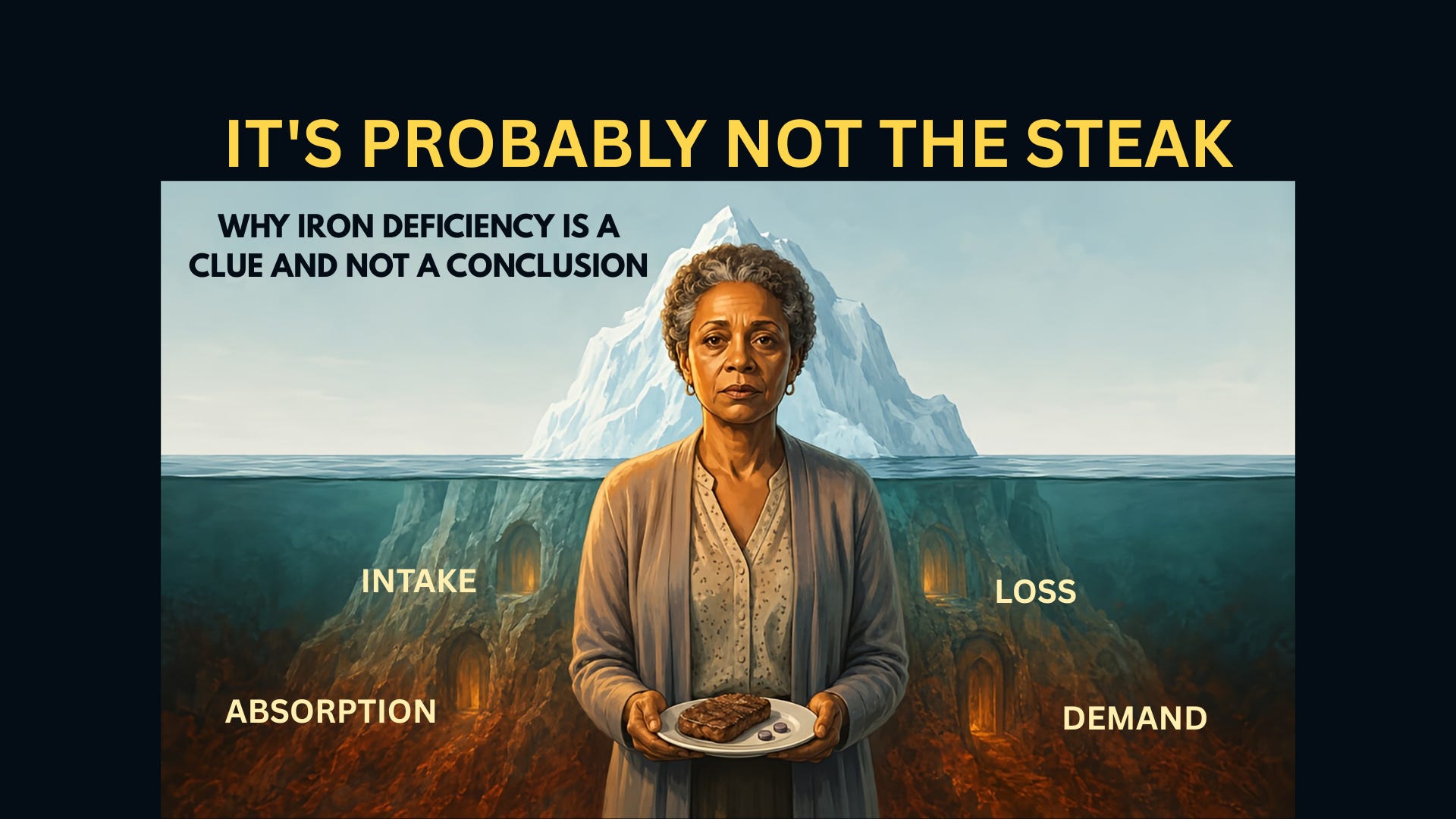
Diane is 48, and she has been tired for the better part of two years.
Not an ordinary kind of tiredness. It’s the kind sleep doesn’t touch. She takes the stairs at work and arrives at the top with her heart going like she’s been running. Her hair is coming out in the shower. She’s cold when nobody else is cold. Her brain buffers in the middle of her own sentences. For a long time, she assumed it was work, or age, or both, because that’s what everybody kept telling her it was.
Eventually, she pushed for blood tests. Now she’s sitting in an exam room while her doctor, Dr. Whitfield, works down the results, ruling things out as she goes.
Thyroid — fine.
Blood sugar — fine.
Kidneys, liver, inflammatory markers — nothing jumping out.
Then she stops.
“Your iron is low. Your stores look quite depleted. That could explain a lot of this.”
And Diane feels a flood of relief, because at last there’s a name for it, and because she already knows what to do about it. She’s seen the ads. She’s read the posts.
“Okay,” she says, reaching for her bag. “So I’ll get an iron supplement. Eat more red meat, more spinach. Right?”
Dr. Whitfield does not reach for the prescription pad.
“Not so fast,” she says. “Let’s slow down.”
Diane looks up.
“Low iron isn’t the answer. It’s the question. Something is making you low — and until we know what that something is, eating more steak isn’t going to stop it. It may just make the number look better while whatever’s causing it carries on underneath. I don’t want to treat this yet. I want to understand it first.”
That one “not so fast” is what this whole series is about.
Diane’s instinct is the instinct almost everybody has. It’s also the instinct the wellness industry has spent a fortune reinforcing. Symptom, supplement, done. It’s a tidy little loop, it sells extraordinarily well, and it is very nearly useless.
Because iron deficiency is a symptom, not a diagnosis. It’s smoke.
And the useful question is never, “How do I get rid of this smoke?”
It’s always: what’s burning?
A low iron result is the starting point for an investigation.
Almost everything sold to you treats it as the end of one.
First: why does low iron make you feel bad in so many different places?
Look again at Diane’s list. Exhaustion. A racing heart on the stairs. Hair in the drain. Cold hands. A brain losing the end of its own sentence.
Those don’t look like they belong together. Which is exactly why she spent two years being told they were five separate problems — or, more often, no problem at all.
Tired? You’re busy.
Hair thinning? You’re 48.
Foggy? Everyone’s foggy.
They cohere the instant you understand what iron actually does.
Most people believe iron equals hemoglobin — that iron is a blood thing, full stop. That isn’t close to true. Iron isn’t one system’s mineral. It’s infrastructure. And infrastructure doesn’t fail politely in one place; it fails a little bit everywhere, in ways that are easy to dismiss one at a time and impossible to dismiss together.
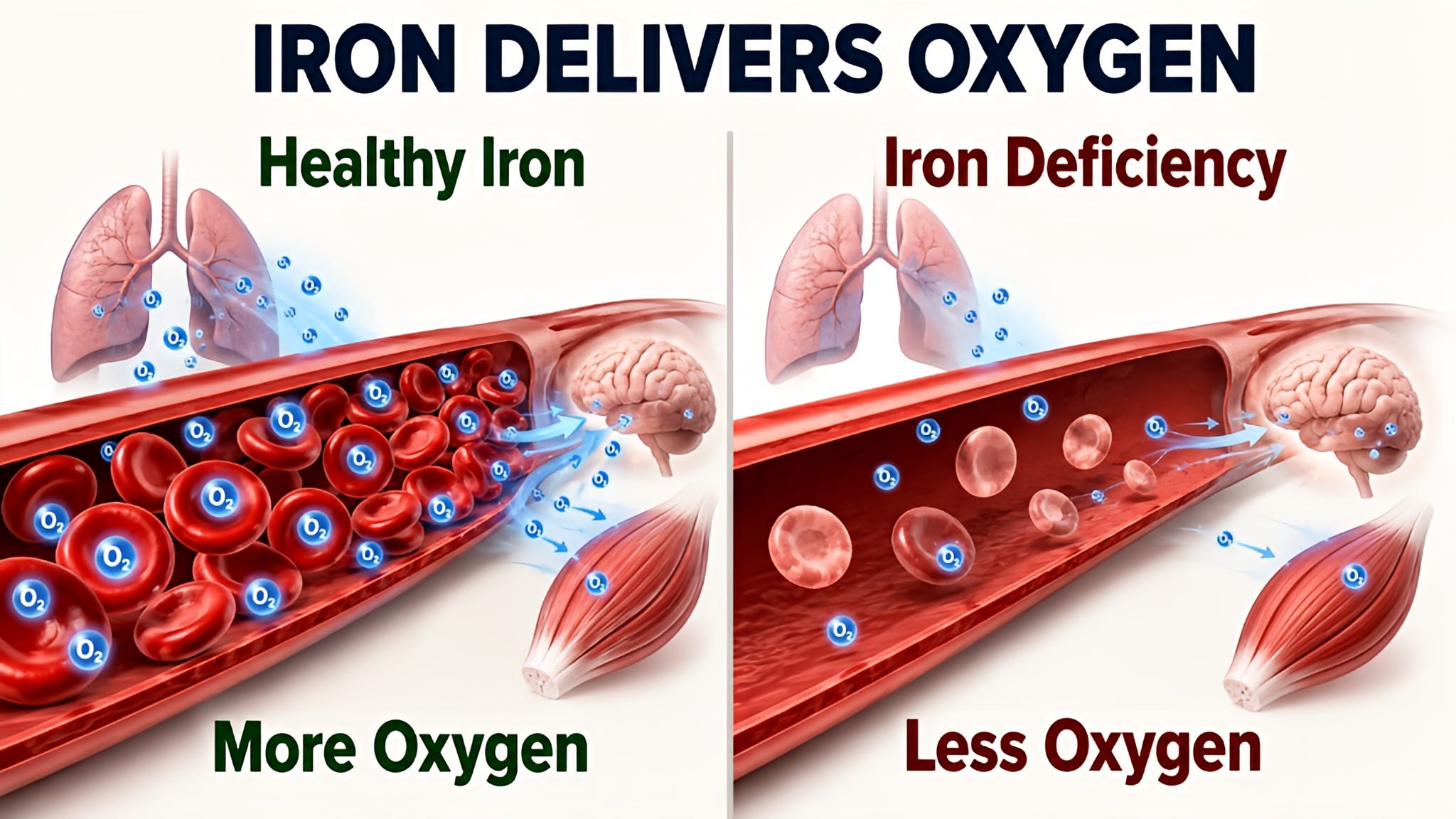
It carries your oxygen.
Two-thirds of your iron sits in hemoglobin (your red blood cells), grabbing oxygen at the lungs and handing it out to your tissues. Run low, and you make fewer, smaller, paler red cells — less cargo space, fewer trucks. That’s the breathlessness, the pallor, and the heart racing on the stairs, because a heart short of oxygen-carrying capacity compensates the only way it can: by beating faster.
That’s the part every article gets right. It’s also the least interesting part.
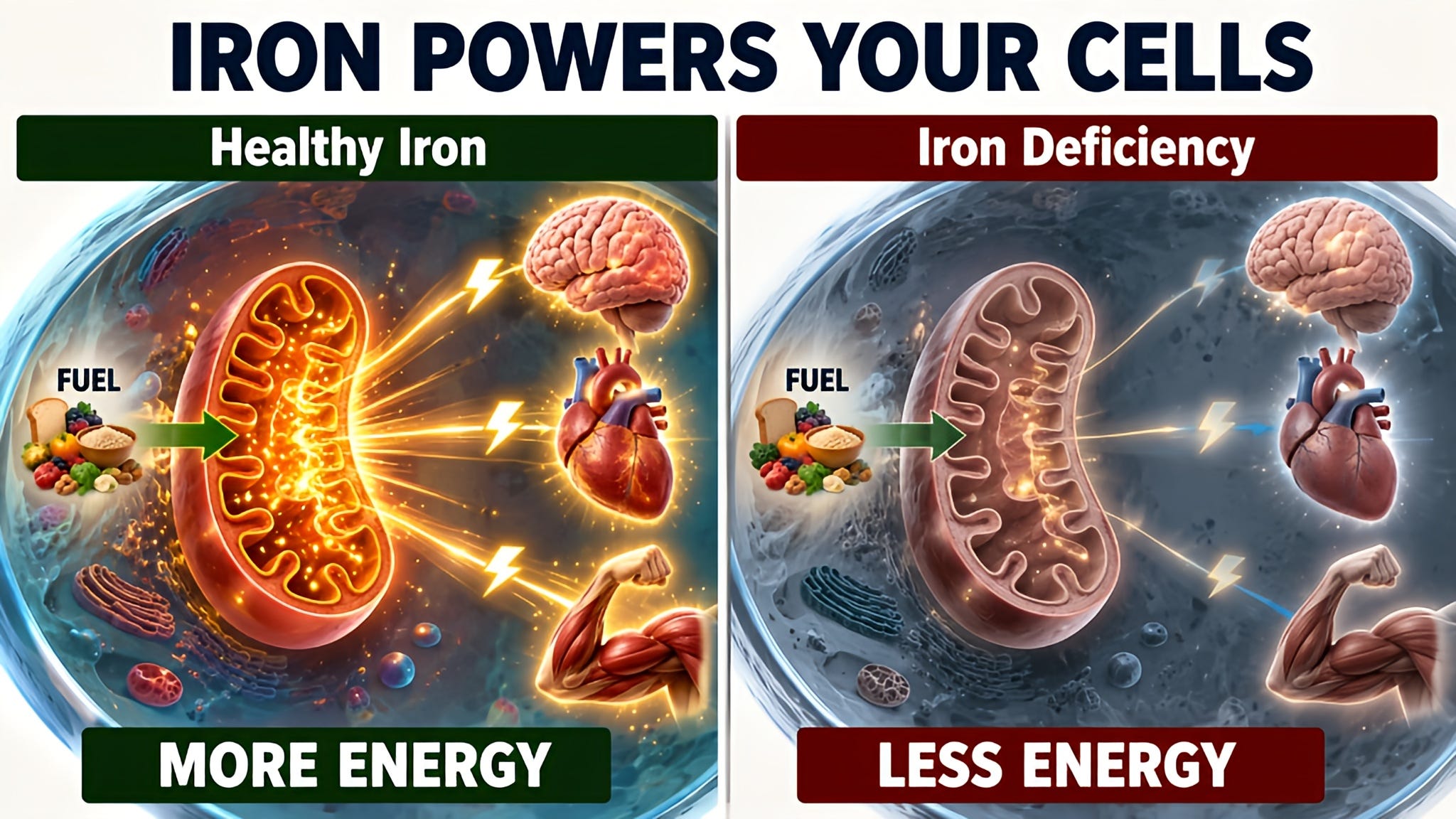
It runs your mitochondria.
The machinery that turns fuel into ATP — the energy you spend to think, move, heal, hold a thought- is built from iron-sulfur clusters and iron-containing proteins. Iron isn’t a bystander in your energy production. It’s a working part of the engine.
This is the bit that gets left out, and it explains something important: if iron only mattered for oxygen delivery, you’d expect to feel fine until your blood count dropped. But that isn’t what happens. People are flattened or tired long before their anemia is severe. And some are flattened, even though their blood counts still read perfectly normal.
The problem isn’t only in the delivery van. It’s at the power plant.
Which is why this tiredness has a quality people struggle to describe to a doctor. It isn’t sleepiness. Sleep doesn’t fix it. A holiday doesn’t fix it. It’s the feeling of running an engine that can’t make enough power; everything is harder than it should be, including the things that are supposed to be free.
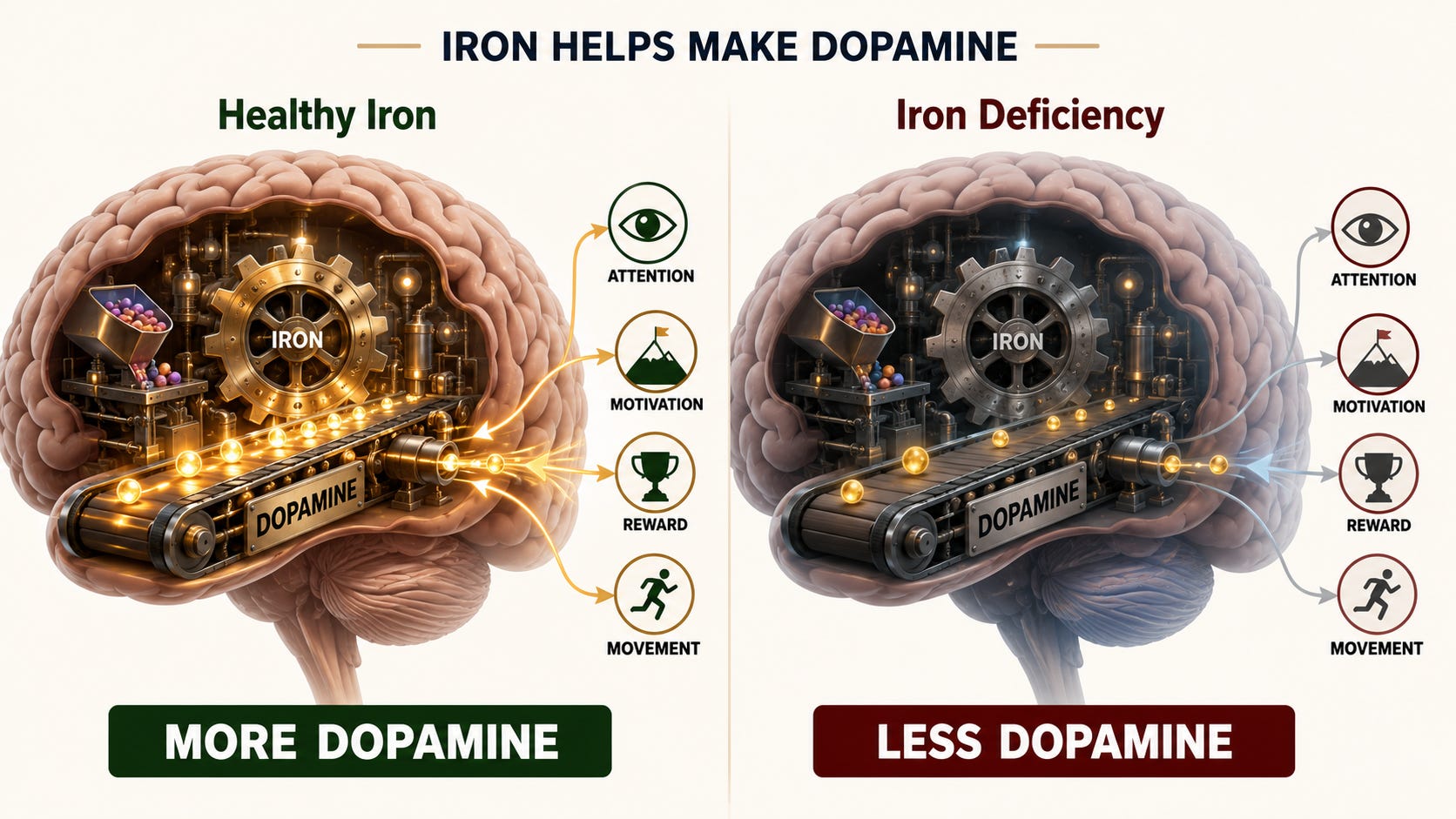
It makes your dopamine.
Iron is the rate-limiting cofactor for tyrosine hydroxylase, the enzyme that manufactures dopamine. Rate-limiting is the key phrase: when iron runs short, the production line slows, no matter how much of everything else is available. Dopamine governs attention, motivation, reward, and movement. Iron also supports serotonin and norepinephrine, and builds the myelin that insulates your nerves.
So a brain short on iron isn’t just a tired brain. It’s a brain running a sluggish dopamine system — the thread connecting iron to brain fog, poor concentration, flattened motivation, irritability, and restless legs. (That opens a set of questions big enough to need their own article. We’ll get there.)
It builds fast-dividing tissue in our body.
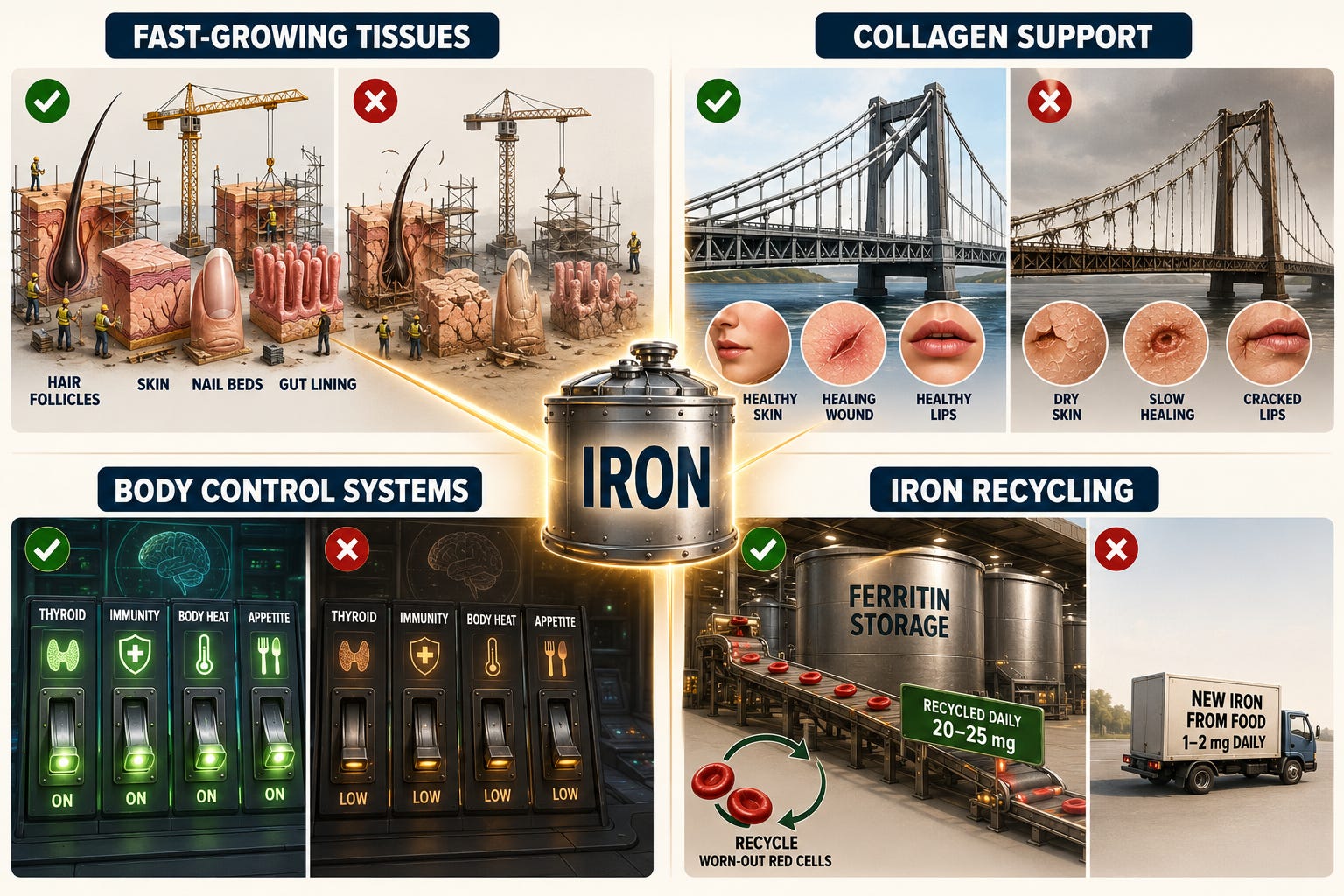
The enzyme that supplies the raw material for new DNA is iron-dependent, so the tissues that divide fastest in our body pay the price first: bone marrow, gut lining, hair follicles, nail beds. It’s a queue. The hair in Diane’s shower drain isn’t a vanity complaint. It’s a signal from a tissue that has run out of raw material.
It holds you together.
The enzymes that stabilize collagen need iron and vitamin C, which work in tandem. Short on either, and the scaffolding gets built badly — dry, itchy, fragile skin; wounds that heal slowly; cracks at the corners of the mouth. These are the symptoms people are least likely to connect to iron and most likely to be sold a cream for.
And it does more than that.
Thyroid hormone production is iron-dependent, so deficiency can worsen an underactive thyroid and mimic one. Immune cells need iron to multiply. Iron helps regulate body temperature, which is the cold intolerance. It even interacts with ghrelin, the hunger hormone — so deficiency can blunt the very appetite that might have corrected it.
Finally — the master switch.
Your liver stores iron as ferritin. Your body recycles about 20–25 mg a day from worn-out red cells and puts them straight back to work. Against that, you only need to absorb 1 to 2 milligrams a day from food to maintain that level.
One to two milligrams. That’s the whole daily requirement. Your body is not running a deficit because you skipped a steak.
And governing all of it is a single hormone: hepcidin. It decides whether iron gets absorbed and released, or locked in the vault where you can’t reach it. Remember that name. It’s about to matter.
So: not five unrelated problems. One shortage, felt everywhere at once.
Your body doesn’t just run low for no reason.
This is the hinge of the whole argument.
Your body is exceptionally good at holding on to iron. It recycles it relentlessly. It hoards it. It needs a trickle a day. It runs an entire hormonal system whose only job is guarding the supply.
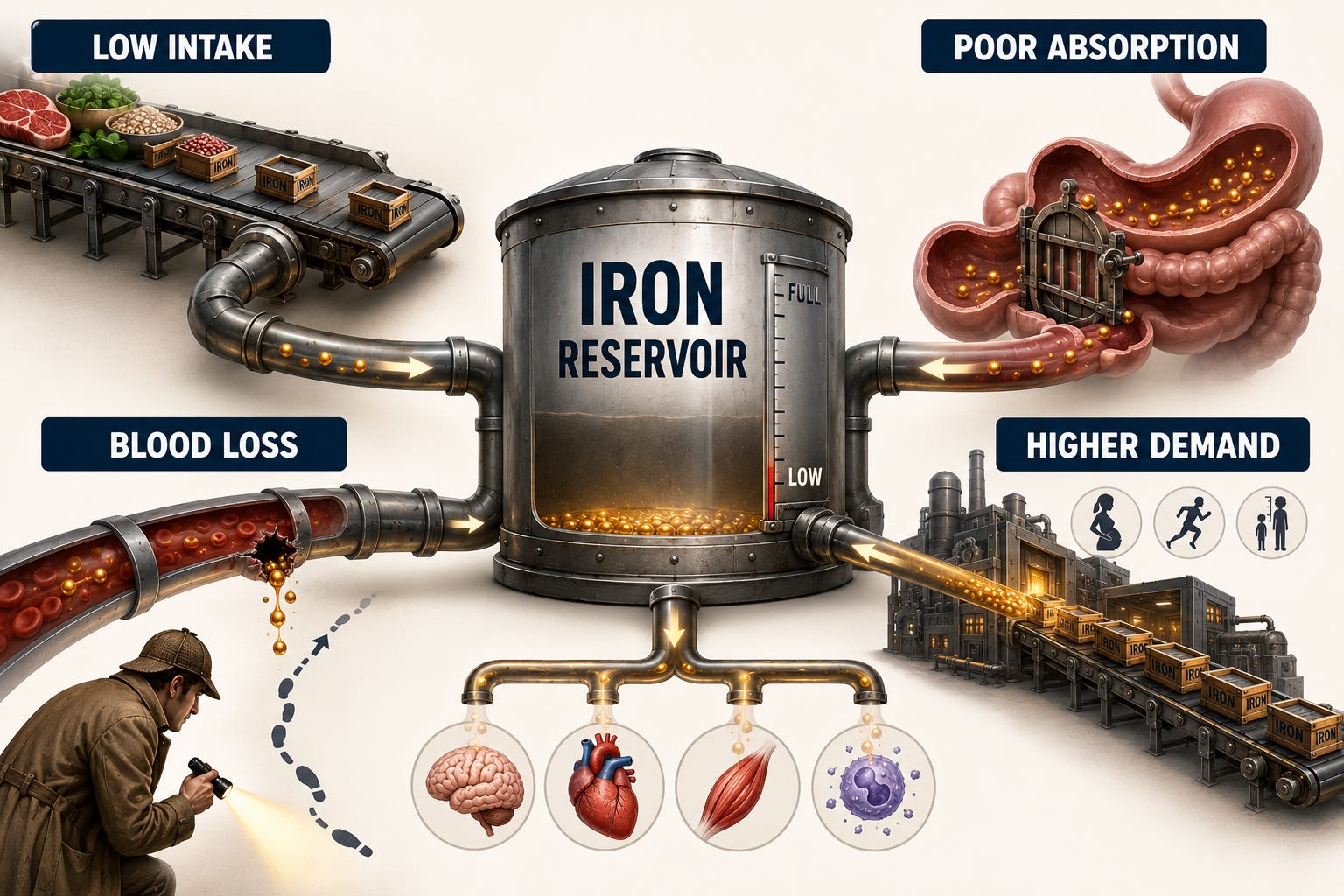
So when the tank is empty, that emptiness means something. It isn’t bad luck. Something has gone wrong upstream — iron isn’t getting in, or it’s blocked on the way through, or it’s leaking out, or the body is burning through it faster than it can be replaced.
Which is why “eat more red meat” is such a strange piece of advice once you look at it squarely. It only helps if the problem was that you weren’t eating enough iron in the first place. If your gut can’t absorb it, more steak won’t fix anything. If you’re quietly bleeding somewhere, more steak won't fix it. It’s like pouring water into a bucket with a hole in it and calling it a solution.
The first useful question is never how do I get more iron. It’s: which of these is actually happening to me?
The four doors
Almost every cause of iron deficiency walks through one of four doors. Plus one impostor who doesn’t use a door at all and is the reason so many people get misread.
Door One — Not enough coming in.
The intake door. The only one a steak can close. Low-heme diets, vegetarian and vegan eating, but also the quiet drift of somebody who simply stopped eating much red meat a few years ago and never noticed. Restrictive dieting. Poor appetite due to age or illness. Appetite-suppressing drugs, including the GLP-1 medications now taken by enormous numbers of people, where intake can collapse without anyone tracking what’s been lost.
The honest note: if this is your only open door, then yes — food and supplements may well fix it. The point isn’t that diet never matters. It’s that you can’t know this is your door until you’ve checked the other three.
Door Two — Coming in, but not absorbed.
You can eat a perfect diet and absorb almost none of it. Behind this door: coeliac disease, which can stay silent for years with iron deficiency as its only outward sign. Autoimmune gastritis. Low stomach acid. Long-term acid-suppressing medication, the reflux drugs millions take daily, and stop thinking of them as drugs at all. H. pylori. Previous gut surgery, including bariatric surgery. Inflammatory bowel disease.
This door explains one of the most maddening patterns in medicine: the person who dutifully takes iron for six months, doesn’t improve, and gets labeled non-compliant.
Door Three — Leaking out.
The most important door, and the most likely to be dangerous. Iron leaves with blood, whether you can see it or not, and mostly you can’t. Heavy menstrual bleeding is comfortably the commonest cause in women of reproductive age and one of the most normalized symptoms in all of medicine. Bleeding in the gut: ulcers, gastritis, inflammation, abnormal vessels, polyps, and cancers, which is why this door gets its own article. Regular aspirin and anti-inflammatory painkillers. Frequent blood donation.
The bleeding that matters most is usually the bleeding you cannot see.
Door Four - Demand outpacing supply.
Pregnancy, where demand climbs steeply, and the stakes extend to the baby. Breastfeeding. Infancy, growth spurts, adolescence. Recovery from surgery or major blood loss. Heavy endurance training.
And the impostor.
There’s a state where the iron is there, in storage, and your tissues are still starving. It’s called functional iron deficiency, and hepcidin drives it. When there’s chronic inflammation anywhere in the body — kidney disease, heart failure, autoimmune disease, obesity-related inflammation, infection — hepcidin rises, and iron gets locked in the vault.
Here’s why that matters more than almost anything else in this series. Ferritin, the standard test for iron stores, also rises with inflammation all on its own. Which means a person can be genuinely iron-starved and still have a ferritin result that reads perfectly normal or high. The test says you’re fine. Your tissues disagree.
This is the common way iron deficiency can get misread, by patients and by doctors. A normal ferritin level doesn’t automatically mean you’re fine.
So what happened to Diane?

Nothing dramatic. Dr. Whitfield didn’t solve it.
She did something better, and rarer: she declined to guess.
She kept asking questions, and two things surfaced that had never been documented in a medical record.
Diane’s periods had become noticeably heavier over the previous couple of years. She’d never thought to mention it because she’d been told, repeatedly, by well-meaning people that this is simply what happens in your forties. It had been normalized into invisibility. That’s Door Three, potentially wide open.
And, almost as an afterthought during the medication review, Diane had been taking a daily heartburn tablet for about six years. She’d long stopped thinking of it as a drug. But that class of medication works by lowering stomach acid — and stomach acid is part of how the body frees iron from food. That’s Door Two, potentially half-closed the whole time.
“Note the word: potentially.”
Because here’s what a neater story would hide from you: at this point, nothing is proven. Diane has two plausible explanations and zero confirmed ones. Plausible isn’t the same as true — and a doctor who stops here has just swapped one lazy answer for two better-informed ones.
So Dr. Whitfield didn’t say, “This is what you have.” She said, “This gives us somewhere to look.”
Which means a fuller picture of the iron itself, not one number. It means asking whether that heavy bleeding has a cause of its own. It means asking whether the absorption problem is really the tablet — or whether the tablet is masking something else that’s been quietly damaging her gut lining for years.
Two plausible causes are not the same as two proven causes. And a third, unlooked-for cause doesn’t care how convincing the first two sounded.
We leave Diane there. Not diagnosed. Investigated.
What’s coming
Diane’s story is the common one. Most iron deficiency turns out to be something ordinary, findable, and fixable — and I’d rather tell you that plainly than frighten you into reading on.
But most is not all.
So we will investigate other stories to understand iron homeostasis in our body as the series progresses.
A low iron result is a question. The answer isn’t on a supplement label. But leaving you with the question and no way to answer it would be its own kind of failure — so here’s what’s ahead:
The vocabulary in this chapter and series is honest. Because deficiency, anemia, and overload are three different things, and they are used interchangeably by people who should know better. And you can be genuinely deficient and genuinely symptomatic, long before a test calls you “anemic.”
The tests to ask for, and how to read them. We will learn what a full iron panel actually contains, and why a lone ferritin report can lie to you. We will also discuss why a ferritin report must be read, while accounting for inflammation. This might require extra tests to belong on the form, depending on which door is open.
What must be ruled out, and in what order? Not by how common something is, but by how much it costs to miss it.
Your actual odds. The likelihood of each cause isn’t the same for everybody. It shifts enormously with age, sex, ancestry, medication, and history. A twenty-six-year-old with heavy periods and a sixty-four-year-old man are not running the same risk, and it does neither of them any favors to pretend otherwise.
Which groups carry which risks? Pregnancy and postpartum. Perimenopause. Older adults. Vegetarians and vegans. Athletes. Blood donors. People on acid-suppressants, painkillers, or appetite-suppressing drugs. After gut surgery. Children and teenagers. Certain ancestries, where inherited blood traits change how results must be read.
The look-alikes. Conditions that produce exactly these symptoms without being iron deficiency — and, more treacherously, the ones that both imitate it and cause it.
The other danger. Too much iron is its own disease. Your body has no efficient way to get rid of the surplus. “More is better” is a genuinely harmful idea.
What to say at the appointment. The questions, the scripts, and the sentences that turn five minutes into a real investigation.
What this series isn’t
It isn’t a supplement pitch. I won’t be telling you what brand to buy, and I have no interest in the reflex that converts every symptom into a bottle. Where the answer is genuinely simple, I’ll tell you it’s simple — that runs in both directions.
It also isn’t a manual for treating yourself. Please don’t start ironing on the strength of something you read, including this. Iron you don’t need isn’t harmless, and a signal you’ve masked is a signal you’ve lost.
What it is is a way to walk into that exam room already halfway through the conversation Dr. Whitfield started.
Dr. Whitfield was right to slow down.
The rest of this series is about what she looked for next.
Subscribe to get the whole series — including the deeper pieces on the four doors, the causes nobody should miss, and the appointment playbook.
Educational content, not medical advice — written to make your conversation with a qualified clinician better, never to replace it. Iron should only be started, stopped, or changed with a doctor who knows your full picture. Diane, Marcus, and Dr. Whitfield are fictional composites, assembled from patterns that recur constantly in the clinical literature.
Hi! I just subscribed! Iron deficiency runs in my family, mom has it, aunt has it, and I have low iron, but it's not a deficiency. My sister had dangerously low iron, and the doctor prescribed medicine, but two weeks later we found out that she had celiac disease. I love that you said that iron deficiency is just a symptom, not a diagnosis, because in my case, for my mom and grandma it is just a deficiency, but for my sister it was a complete different case. I wish I found this earlier so we could've tested my sister sooner, but I'm glad that we know now, otherwise she would've been tired and out of energy for longer. I'm excited to read more of your posts!